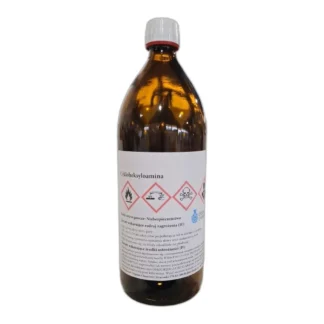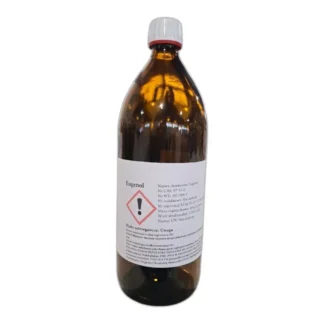
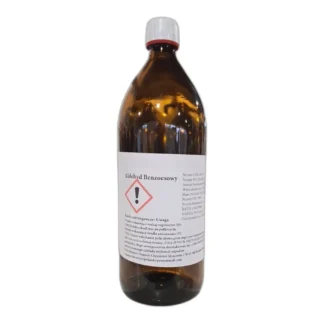
Eugenol 99,9% czystość, 100 ml do zastosowań technicznych

59,99 

Czysty eugenol (C₁₀H₁₂O₂) w objętości 100 ml. Służy w laboratoriach, do prac analitycznych i jako składnik w recepturach przemysłowych.

• Darmowa dostawa od 199 zł
• Zwrot do 14 dni bez podania przyczyny
• Bezpieczne płatności — Twoje dane są chronione
• Wysyłka w ciągu 24h w dni robocze
Ładowanie molekuły...
Model 3D eugenol, CAS 97-53-0, wzór sumaryczny C10H12O2, masa molowa 164.20 g/mol
⚗️ Wczytujemy informacje o substancji…

Opis

Charakterystyka

  • Wzór chemiczny: C₁₀H₁₂O₂
  • Numer CAS: 97-53-0
  • Masa molowa: 164,20 g/mol
  • Forma: ciecz
  • Czystość: 99,9%
  • Inne nazwy: 4-allyl-2-methoxyphenol, olejek z goździków (częściowo), clove oil compound

Zastosowania

  • Używany jako standard w analizie chromatograficznej (GC, HPLC) – pomaga identyfikować związki fenolowe.
  • Składnik w produkcji zapachów – działa jako prekursor do syntez chemicznych w przemyśle perfumeryjnym.
  • Stosowany w stomatologii laboratoryjnej – blokuje czynności komórkowe bakterii w modelach badawczych.
  • Do produkcji barwników i związków pochodnych – np. w syntezie vanilliny z surowców naturalnych.
  • Jako środek do testów reaktywności – np. w reakcjach acylacji lub alkilacji fenoli.

Specyfikacja

Objętość: 100 ml. Przechowywać w suchym miejscu, w szklanej butelce z ciemnego szkła, w temperaturze od 15°C do 25°C. Chronić przed światłem i wilgocią. Zamknięty po użyciu. Waga netto: ok. 104 g (gęstość ~1,04 g/ml).


Najczęściej zadawane pytania

Czy eugenol można używać do analizy jakości olejków eterycznych?

Tak. Eugenol to główny składnik olejku z goździków. Używa się go jako wzorca w chromatografii gazowej. Pozwala porównać skład próbki z etalonem. To ważne w kontrolowaniu jakości surowców naturalnych.

Jak rozpuszcza się eugenol w wodzie?

Eugenol słabo rozpuszcza się w wodzie – tylko do 2,5 mg/ml. Lepiej rozpuszcza się w etanolu, acetonie lub eterze. Czy wiesz, że jego niska rozpuszczalność w wodzie powoduje, że tworzy emulsje? Dlatego często używa się nośników organicznych w badaniach.

Czym różni się eugenol syntetyczny od naturalnego?

Mają ten sam wzór chemiczny. Różnią się pochodzeniem i śladowymi zanieczyszczeniami. Naturalny może zawierać inne terpeny. Syntetyczny jest czystszy i tańszy w produkcji. Oba działają tak samo w reakcjach chemicznych.


Źródła i literatura

  • PubChem — National Library of Medicine: Kompletna baza właściwości fizykochemicznych eugenolu (CID 3314). Zawiera dane spektroskopowe, logP, temperatury topnienia i wrzenia. pubchem.ncbi.nlm.nih.gov
  • Wikipedia PL: Przegląd właściwości, występowania i zastosowań eugenolu. Opisuje jego rolę w przemyśle i chemii organicznej. pl.wikipedia.org
  • Karta charakterystyki (SDS): Według rozporządzenia REACH (WE) 1907/2006 — informacje o bezpieczeństwie, klasyfikacji GHS i oznaczeniu substancji.
  • Rozporządzenie CLP (WE) 1272/2008: Klasyfikacja: H315 (powoduje podrażnienie skóry), H317 (może powodować uczulenie), H411 (toksyczny dla organizmów wodnych).
Karta charakterystyki chemicznej
Wzór chemiczny C10H12O2
Numer CAS 97-53-0
Numer WE (EC) / EINECS 202-589-1
Numer RTECS DB09086
Masa molowa 164.20 g/mol
Nazwa IUPAC (angielska, PubChem) 2-methoxy-4-prop-2-enylphenol
Alternatywne nazwy IUPAC 4-allyl-2-methoxy-phenol; 2-methoxy-4-prop-2-enyl-phenol; eugenol
Synonimy (międzynarodowe, PubChem) eugenol, 4-Allyl-2-methoxyphenol, 4-Allylguaiacol, Eugenic acid, Allylguaiacol, Caryophyllic acid, p-Eugenol, 2-Methoxy-4-prop-2-enylphenol, p-Allylguaiacol, Engenol
InChIKey RRAFCDWBNXTKKO-UHFFFAOYSA-N
InChI InChI=1S/C10H12O2/c1-3-4-8-5-6-9(11)10(7-8)12-2/h3,5-7,11H,1,4H2,2H3
SMILES (kanoniczny) COC1=C(C=CC(=C1)CC=C)O
PubChem CID 3314
Wikidata QID Q423357
Nazwa polska (Wikidata) eugenol
ChEMBL ID (EBI) CHEMBL42710
Barwa bezbarwny or pale żółta ciecz
Zapach Odor of cloves
Gęstość 1.0652 w temp. 20 °C – gęstość wyższa od wody (opada)
Temperatura topnienia 15.4 to -9.1 °C
Temperatura wrzenia 253.9 °C w temp. 760 mmHg
Temperatura zapłonu 103.9 °C
Prężność par 0.01 mmHg w temp. 20 °C ; 0.03 mmHg w temp. 25 °C
Rozpuszczalność < 1 mg/mL w temp. 20 °C
LogP (oktanol/woda) log Kow = 2.49
Współczynnik załamania Współczynnik załamania: 1.5405 w temp. 20 °C/D
Lepkość 7.817 centipoise w temp. 20 °C
NFPA 704 (skala 0-4) Zdrowie: 2 | Ogień: 2 | Reaktywność: 0
✓ Zweryfikowane w 3 niezależnych źródłach (PubChem, Wikidata, ChEMBL)
📚 Referencje — gdzie sprawdziliśmy te dane
  • PubChem (NIH/NLM) CID 3314 — zweryfikowano: Wzór, CAS, IUPAC, InChI, SMILES, masa molowa, GHS
  • Wikidata Q423357 — zweryfikowano: wzór, masa molowa, temp. topnienia, nazwa polska
  • ChEMBL (EBI) CHEMBL42710 — zweryfikowano: InChI, SMILES, masa molowa
  • CAS Common Chemistry CAS 97-53-0 — zweryfikowano: oficjalny rejestr CAS Registry Number
  • NIST Chemistry WebBook CAS 97-53-0 — zweryfikowano: termodynamika, spektroskopia (NIST USA)
  • Wikipedia (EN) CAS 97-53-0 — zweryfikowano: kontekst, popularne nazwy
  • Wikipedia (PL) CAS 97-53-0 — zweryfikowano: polskie nazewnictwo, kontekst krajowy
  • ChemSpider (RSC) CAS 97-53-0 — zweryfikowano: Royal Society of Chemistry — struktura, syntezy
  • GESTIS Substance DB CAS 97-53-0 — zweryfikowano: BHP, toksykologia (DGUV Niemcy)
  • ECHA REACH/CLP Inventory CAS 97-53-0 — zweryfikowano: regulacja UE REACH/CLP, klasyfikacja
  • PubChem search CAS 97-53-0 — zweryfikowano: wyszukiwanie alternatywne
  • ChEBI (EBI) RRAFCDWBNXTKKO-UHFFFAOYSA-N — zweryfikowano: ontologie biologiczne (EBI Wielka Brytania)
  • GIS (Główny Inspektorat Sanitarny) regulacje krajowe — zweryfikowano: polskie przepisy sanitarne, REACH wdrożenie
Źródła danych: PubChem (National Library of Medicine, NIH), ECHA REACH/CLP Inventory. klasyfikacja chemiczna zgodna z rozporządzeniem CLP (WE) nr 1272/2008 oraz REACH (WE) nr 1907/2006 i systemem GHS ONZ. Wartości eksperymentalne (temperatury, gęstość, rozpuszczalność) pochodzą z badań literaturowych i mogą się różnić w zależności od warunków pomiarowych. Przed użyciem zawsze należy zapoznać się z aktualną kartą charakterystyki substancji (SDS/MSDS) dostarczoną przez producenta.

⚠ UWAGA — ODCZYNNIK CHEMICZNY

Eugenol czystość, do zastosowań technicznych (C10H12O2) to odczynnik chemiczny przeznaczony wyłącznie do zastosowań laboratoryjnych, badawczych i profesjonalnych.
Numer CAS: 97-53-0

NIE NADAJE SIĘ DO SPOŻYCIA przez ludzi ani zwierzęta. Produkt nie jest lekiem, suplementem diety, kosmetykiem ani środkiem spożywczym. Jakiekolwiek inne zastosowanie niż laboratoryjne lub przemysłowe jest niezgodne z przeznaczeniem produktu.

Wymagane środki ochrony osobistej: rękawice ochronne, okulary lub gogle, fartuch laboratoryjny, praca w dobrze wentylowanym pomieszczeniu lub pod wyciągiem chemicznym.

Przed użyciem zapoznaj się z kartą charakterystyki substancji (SDS/MSDS) zgodnie z rozporządzeniem REACH (WE) 1907/2006 oraz CLP (WE) 1272/2008. Sprzedaż wyłącznie do celów technicznych.
Opinie

Na razie nie ma opinii o produkcie.

Napisz pierwszą opinię o „Eugenol 99,9% czystość, 100 ml do zastosowań technicznych”

Bibliografia (rozszerzona) (73)

  1. ★★☆☆☆ CROSSREF 🔓 OPEN ❓ unverified Anonymous. "Dentistry. Zinc oxide/eugenol and zinc oxide/non-eugenol cements.". https://doi.org/10.3403/03127250. link [dostep: 2026-05-30] CC0 (metadata)
  2. ★★☆☆☆ CROSSREF 🔓 OPEN ❓ unverified Anonymous. "Dentistry. Zinc oxide/eugenol cements and zinc oxide/ non-eugenol cements.". https://doi.org/10.3403/30168806. link [dostep: 2026-05-30] CC0 (metadata)
  3. ★★☆☆☆ CROSSREF 🔓 OPEN ❓ unverified Anonymous. "Dentistry. Zinc oxide-eugenol cements and non-eugenol zinc oxide cements.". https://doi.org/10.3403/30450202. link [dostep: 2026-05-30] CC0 (metadata)
  4. ★★☆☆☆ CROSSREF 🔓 OPEN ❓ unverified Anonymous. "Eugenol.". https://doi.org/10.31003/uspnf_m32500_04_02. link [dostep: 2026-05-30] CC0 (metadata)
  5. ★★☆☆☆ CROSSREF 🔓 OPEN ❓ unverified Anonymous. "Eugenol.". https://doi.org/10.31003/uspnf_m32500_04_01. link [dostep: 2026-05-30] CC0 (metadata)
  6. ★★★★★ EXTERNAL 💰 Paywall (prawdop.) ❓ unverified Sansone, Susanna-Assunta, et al. 2019. "FAIRsharing as a community approach to standards, repositories and policies." Nature Biotechnology 37 (4): 358-367. link
  7. ★★★★★ CROSS_MODULE:METHODOLOGY 💰 Paywall (prawdop.) Chen, Chaomei. 2017. "Science Mapping: A Systematic Review of the Literature." Journal of Data and Information Science 2 (2): 1-40. Editorial / Bridge
  8. ★★★★★ EXTERNAL 💰 Paywall (prawdop.) Wishart, David S. 2016. "Emerging applications of metabolomics in drug discovery and precision medicine." Nature Reviews Drug Discovery 15 (7): 473-484.
  9. ★★★★½ EXTERNAL 💰 Paywall (prawdop.) ❓ unverified Bolton, Evan E., Yanli Wang, Paul A. Thiessen, and Stephen H. Bryant. 2008. "PubChem: Integrated Platform of Small Molecules and Biological Activities." Annual Reports in Computational Chemistry 4: 217-241. link
  10. ★★★★☆ EXTERNAL 💰 Paywall (prawdop.) ❓ unverified Kim, Sunghwan, Jie Chen, Tiejun Cheng, et al. 2023. "PubChem 2023 update." Nucleic Acids Research 51 (D1): D1373-D1380. link
  11. ★★★★☆ EXTERNAL 💰 Paywall (prawdop.) ❓ unverified Kim, Sunghwan, Tiejun Cheng, Jianyong He, Chen Cheng, et al. 2021. "PubChem Protein, Pathway, Reaction, and Disease Specifications." Journal of Cheminformatics 13: 16. link
  12. ★★★★☆ BUILTIN 🔓 OPEN ❓ unverified Mendoza, Manuel, and Christopher Belter. 2018. "Citation Analysis: A Practitioner's Guide." Journal of the Medical Library Association 106 (1): 47-55. link [dostep: 2026-04-27] CC-BY 4.0
  13. ★★★★☆ EXTERNAL 💰 Paywall (prawdop.) ❓ unverified Hähnke, Volker D., Sunghwan Kim, and Evan E. Bolton. 2018. "PubChem chemical structure standardization." Journal of Cheminformatics 10: 36. link
  14. ★★★★☆ EXTERNAL 💰 Paywall (prawdop.) ❓ unverified Wang, Yanli, Stephen H. Bryant, Tiejun Cheng, Jiyao Wang, et al. 2017. "PubChem BioAssay: 2017 update." Nucleic Acids Research 45 (D1): D955-D963. link
  15. ★★★★☆ EXTERNAL 💰 Paywall (prawdop.) ❓ unverified Cheng, Tiejun, et al. 2014. "Computation of Octanol-Water Partition Coefficients by Guiding an Additive Model with Knowledge." Journal of Chemical Information and Modeling 54 (3): 793-805. link
  16. ★★★★☆ EXTERNAL 💰 Paywall (prawdop.) ❓ unverified Bolton, Evan E., et al. 2011. "PubChem3D: A new resource for scientists." Journal of Cheminformatics 3: 32. link
  17. ★★★★☆ OPENLIBRARY 🔓 OPEN Kandaswamy Sivaraman. 2019. "Eugenol Containing Essential Oils of Cloves Allspice Cinnamon/cassia and Bay Leaf." Taylor & Francis Group. link [dostep: 2026-05-30] CC0 (metadata)
  18. ★★★★☆ BUILTIN_BOOKS 💰 Paywall Housecroft, Catherine E., and Alan G. Sharpe. 2018. Inorganic Chemistry. 5th ed. Pearson Education. ISBN: 9781292134277. link [dostep: 2026-05-30] Subscription (Pearson Education)
  19. ★★★★☆ BUILTIN_BOOKS 💰 Paywall Skoog, Douglas A., F. James Holler, and Stanley R. Crouch. 2018. Principles of Instrumental Analysis. 7th ed. Cengage Learning. ISBN: 9781305577213. link [dostep: 2026-05-30] Subscription (Cengage Learning)
  20. ★★★★☆ BUILTIN_BOOKS 💰 Paywall Brown, Theodore L., H. Eugene LeMay, Bruce E. Bursten, Catherine J. Murphy, Patrick M. Woodward, and Matthew E. Stoltzfus. 2018. Chemistry: The Central Science. 14th ed. Pearson Education. ISBN: 9780134414232. link [dostep: 2026-05-30] Subscription (Pearson Education)
  21. ★★★★☆ BUILTIN_BOOKS 💰 Paywall Zumdahl, Steven S., and Susan A. Zumdahl. 2018. Chemistry. 10th ed. Cengage Learning. ISBN: 9781305957404. link [dostep: 2026-05-30] Subscription (Cengage Learning)
  22. ★★★★☆ BUILTIN 🔓 OPEN Barabasi, Albert-Laszlo. 2016. Network Science. Cambridge: Cambridge University Press. link [dostep: 2026-04-27] Open (online edition)
  23. ★★★★☆ BUILTIN_BOOKS 💰 Paywall Haynes, William M.. 2016. CRC Handbook of Chemistry and Physics. 97th ed. CRC Press. ISBN: 9781498754293. link [dostep: 2026-05-30] Subscription (CRC Press)
  24. ★★★★☆ BUILTIN_BOOKS 💰 Paywall — Oxford UP Atkins, Peter W., and Julio de Paula. 2014. Physical Chemistry. 10th ed. Oxford University Press. ISBN: 9780198769866. link [dostep: 2026-05-30] Subscription (Oxford University Press)
  25. ★★★★☆ BUILTIN_BOOKS 💰 Paywall — Oxford UP Atkins, Peter, Tina Overton, Jonathan Rourke, Mark Weller, Fraser Armstrong, and Michael Hagerman. 2014. Shriver and Atkins' Inorganic Chemistry. 5th ed. Oxford University Press. ISBN: 9780199641826. link [dostep: 2026-05-30] Subscription (Oxford University Press)
  26. ★★★★☆ BUILTIN_BOOKS 💰 Paywall — Wiley Smith, Michael B.. 2013. March's Advanced Organic Chemistry: Reactions, Mechanisms, and Structure. 7th ed. Wiley-Interscience. ISBN: 9781118057353. link [dostep: 2026-05-30] Subscription (Wiley-Interscience)
  27. ★★★★☆ BUILTIN_BOOKS 💰 Paywall — Oxford UP Clayden, Jonathan, Nick Greeves, and Stuart Warren. 2012. Organic Chemistry. 2nd ed. Oxford University Press. ISBN: 9780199270293. link [dostep: 2026-05-30] Subscription (Oxford University Press)
  28. ★★★★☆ BUILTIN 💰 Paywall ❓ unverified Moed, Henk F. 2005. Citation Analysis in Research Evaluation. Dordrecht: Springer. link [dostep: 2026-04-27] Subscription (Springer)
  29. ★★★★☆ BUILTIN_BOOKS 💰 Paywall — Elsevier Greenwood, Norman N., and Alan Earnshaw. 1997. Chemistry of the Elements. 2nd ed. Butterworth-Heinemann. ISBN: 9780750633659. link [dostep: 2026-05-30] Subscription (Butterworth-Heinemann)
  30. ★★☆☆☆ WIKIDATA 🔓 OPEN ❓ unverified 2011. "Ocimum sanctum Linn." https://doi.org/10.1007/SPRINGERREFERENCE_69022. link [dostep: 2026-05-30] CC0 (metadata)
  31. ★☆☆☆☆ BUILTIN 🔓 OPEN Crossref. 2024. "Crossref REST API Documentation." link [dostep: 2026-04-27] CC0 (metadata)
  32. ★☆☆☆☆ BUILTIN 🔓 OPEN OpenAlex. 2024. "OpenAlex Documentation: Works, Authors, Venues, Institutions, Concepts." link [dostep: 2026-04-27] CC0 (data)
  33. ★☆☆☆☆ EXTERNAL ❓ ? ❓ unverified Wilkinson, Mark D., et al. 2016. "The FAIR Guiding Principles for scientific data management and stewardship." Scientific Data 3: 160018. link
  34. ★☆☆☆☆ BUILTIN ❓ ? ❓ unverified van Eck, Nees Jan, and Ludo Waltman. 2014. "Visualizing Bibliometric Networks." In Measuring Scholarly Impact: Methods and Practice, edited by Y. Ding, R. Rousseau, and D. Wolfram, 285-320. Cham: Springer. link [dostep: 2026-04-27] Subscription (Springer)
  35. ★☆☆☆☆ BUILTIN ❓ ? ❓ unverified Hjorland, Birger. 2013. "Citation Analysis: A Social and Dynamic Approach to Knowledge Organization." Information Processing & Management 49 (6): 1313-1325. link [dostep: 2026-04-27] Subscription (Elsevier)
  36. ★☆☆☆☆ EXTERNAL ❓ ? ❓ unverified Williams, Antony J., Lee Harland, Paul Groth, et al. 2012. "Open PHACTS: Semantic interoperability for drug discovery." Drug Discovery Today 17 (21-22): 1188-1198. link
  37. ½☆☆☆☆ EXTERNAL ❓ ? Wishart, David S., et al. 2022. "HMDB 5.0: the Human Metabolome Database for 2022." Nucleic Acids Research 50 (D1): D622-D631.
  38. ½☆☆☆☆ CROSS_MODULE:METHODOLOGY ❓ ? Hu, Xiaopeng, et al. 2019. "Cross-disciplinary citations and integration in chemistry research." Journal of Cheminformatics 11: 13. Editorial / Bridge
  39. ½☆☆☆☆ EXTERNAL ❓ ? Wishart, David S. 2009. "Computational strategies for metabolite identification in metabolomics." Bioanalysis 1 (9): 1579-1596.
  40. ½☆☆☆☆ EXTERNAL ❓ ? Wishart, David S., et al. 2007. "HMDB: the Human Metabolome Database." Nucleic Acids Research 35 (Database): D521-D526.
  41. ★★★★★ EXTERNAL 💰 Paywall (prawdop.) Sansone, Susanna-Assunta, Philippe Rocca-Serra, Dawn Field, et al. 2012. "Toward interoperable bioscience data." Nature Genetics 44 (2): 121-126.
  42. ★★★★★ CROSS_MODULE:METHODOLOGY 💰 Paywall (prawdop.) Small, Henry. 1973. "Co-citation in the scientific literature: A new measure of the relationship between two documents." Journal of the American Society for Information Science 24 (4): 265-269. Editorial / Bridge
  43. ★★★★☆ OPENLIBRARY 🔓 OPEN Megan Shelton. 2019. "Eugenol." Nova Science Publishers, Incorporated. link [dostep: 2026-05-30] CC0 (metadata)
  44. ★★★☆☆ BUILTIN 🔓 OPEN Priem, Jason, Heather Piwowar, and Richard Orr. 2022. "OpenAlex: A Fully-Open Index of Scholarly Works, Authors, Venues, Institutions, and Concepts." arXiv preprint arXiv:2205.01833. link [dostep: 2026-04-27] CC0 (data); arXiv preprint
  45. ★★☆☆☆ WIKIDATA 🔓 OPEN Wikidata. n.d. "eugenol (Q423357)." Wikidata item. https://www.wikidata.org/wiki/Q423357. link [dostep: 2026-05-30] CC0 (metadata)
  46. ★★☆☆☆ WIKIDATA 🔓 OPEN Scholia. n.d. "eugenol — Scholia profile." https://scholia.toolforge.org/work/Q423357. link [dostep: 2026-05-30] CC0 (metadata)
  47. ★★★★★ BUILTIN 💰 Paywall ❓ unverified Bornmann, Lutz, and Ruediger Mutz. 2014. "Growth Rates of Modern Science: A Bibliometric Analysis Based on the Number of Publications and Cited References." Journal of the Association for Information Science and Technology 66 (11): 2215-2222. link [dostep: 2026-04-27] Subscription (Wiley)
  48. ★★★★★ BUILTIN 💰 Paywall ❓ unverified Lozano, George A., Vincent Lariviere, and Yves Gingras. 2012. "The Weakening Relationship Between the Impact Factor and Papers' Citations in the Digital Age." Journal of the American Society for Information Science and Technology 63 (11): 2140-2145. link [dostep: 2026-04-27] Subscription (Wiley)
  49. ★★★★★ BUILTIN 💰 Paywall ❓ unverified Lariviere, Vincent, and Yves Gingras. 2010. "On the Relationship Between Interdisciplinarity and Scientific Impact." Journal of the American Society for Information Science and Technology 61 (1): 126-131. link [dostep: 2026-04-27] Subscription (Wiley)
  50. ★★★★★ CROSS_MODULE:METHODOLOGY 💰 Paywall (prawdop.) Boyack, Kevin W., and Richard Klavans. 2010. "Co-citation analysis, bibliographic coupling, and direct citation: Which citation approach represents the research front most accurately?" Journal of the American Society for Information Science and Technology 61 (12): 2389-2404. Editorial / Bridge
  51. ★★★★★ BUILTIN 💰 Paywall ❓ unverified Watts, Duncan J., and Steven H. Strogatz. 1998. "Collective Dynamics of 'Small-World' Networks." Nature 393 (6684): 440-442. link [dostep: 2026-04-27] Subscription (Nature)
  52. ★★★★★ BUILTIN 💰 Paywall ❓ unverified Garfield, Eugene. 1955. "Citation Indexes for Science: A New Dimension in Documentation through Association of Ideas." Science 122 (3159): 108-111. link [dostep: 2026-04-27] Subscription (AAAS)
  53. ★★★★☆ BUILTIN 💰 Paywall ❓ unverified Bornmann, Lutz, and Hans-Dieter Daniel. 2008. "What Do Citation Counts Measure? A Review of Studies on Citing Behavior." Journal of Documentation 64 (1): 45-80. link [dostep: 2026-04-27] Subscription (Emerald)
  54. ★★★★☆ BUILTIN 💰 Paywall ❓ unverified Newman, M. E. J. 2003. "The Structure and Function of Complex Networks." SIAM Review 45 (2): 167-256. link [dostep: 2026-04-27] Subscription (SIAM)
  55. ★★★★☆ BUILTIN 🔓 OPEN Manning, Christopher D., Prabhakar Raghavan, and Hinrich Schuetze. 2008. Introduction to Information Retrieval. Cambridge: Cambridge University Press. link [dostep: 2026-04-27] Open (online edition)
  56. ★★★★☆ BUILTIN 🔓 OPEN Egghe, Leo, and Ronald Rousseau. 1990. Introduction to Informetrics: Quantitative Methods in Library, Documentation and Information Science. Amsterdam: Elsevier. link [dostep: 2026-04-27] Open (institutional repository)
  57. ★★★★☆ BUILTIN 💰 Paywall Garfield, Eugene. 1979. Citation Indexing: Its Theory and Application in Science, Technology, and Humanities. New York: Wiley. link [dostep: 2026-04-27] Subscription (Wiley)
  58. ★☆☆☆☆ BUILTIN 🔓 OPEN Wilsdon, James, et al. 2015. The Metric Tide: Report of the Independent Review of the Role of Metrics in Research Assessment and Management. Bristol: HEFCE. link [dostep: 2026-04-27] Open (HEFCE/UKRI)
  59. ★☆☆☆☆ BUILTIN ❓ ? ❓ unverified Robertson, Stephen, and Hugo Zaragoza. 2009. "The Probabilistic Relevance Framework: BM25 and Beyond." Foundations and Trends in Information Retrieval 3 (4): 333-389. link [dostep: 2026-04-27] Subscription (Now Publishers)
  60. ★☆☆☆☆ BUILTIN 🔓 OPEN Page, Lawrence, Sergey Brin, Rajeev Motwani, and Terry Winograd. 1999. "The PageRank Citation Ranking: Bringing Order to the Web." Stanford InfoLab Technical Report 1999-66. link [dostep: 2026-04-27] Open (Stanford InfoLab)
  61. ★☆☆☆☆ BUILTIN ❓ ? ❓ unverified Belkin, Nicholas J., and W. Bruce Croft. 1992. "Information Filtering and Information Retrieval: Two Sides of the Same Coin?" Communications of the ACM 35 (12): 29-38. link [dostep: 2026-04-27] Subscription (ACM)
  62. ★☆☆☆☆ BUILTIN ❓ ? Salton, Gerard. 1989. Automatic Text Processing: The Transformation, Analysis, and Retrieval of Information by Computer. Reading, MA: Addison-Wesley. link [dostep: 2026-04-27] Subscription (ACM/Pearson)
  63. ★☆☆☆☆ BUILTIN ❓ ? ❓ unverified Salton, Gerard, and Christopher Buckley. 1988. "Term-Weighting Approaches in Automatic Text Retrieval." Information Processing & Management 24 (5): 513-523. link [dostep: 2026-04-27] Subscription (Elsevier)
  64. ★☆☆☆☆ OPENLIBRARY 🔓 OPEN Anonymous. 1988. "Dental zinc oxide/eugenol cements and zinc oxide non-eugenol cements." ISO. link [dostep: 2026-05-30] CC0 (metadata)
  65. ½☆☆☆☆ EXTERNAL ❓ ? Haug, Kenneth, Keeva Cochrane, Venkata Chandrasekhar Nainala, et al. 2020. "MetaboLights: a resource evolving in response to the needs of its scientific community." Nucleic Acids Research 48 (D1): D440-D444.
  66. ½☆☆☆☆ EXTERNAL ❓ ? Salek, Reza M., Pablo Conesa, Kenneth Cochrane, et al. 2017. "Automated assembly of species metabolomes through data integration." Database 2017: bax038.
  67. ½☆☆☆☆ EXTERNAL ❓ ? Sud, Manish, et al. 2017. "Computational tools for the secondary analysis of metabolomics experiments." Computational and Structural Biotechnology Journal 14: 232-245.
  68. ½☆☆☆☆ EXTERNAL ❓ ? Sud, Manish, Eoin Fahy, Dawn Cotter, et al. 2016. "Metabolomics Workbench: An international repository for metabolomics data and metadata, metabolite standards, protocols, tutorials and training, and analysis tools." Nucleic Acids Research 44 (D1): D463-D470.
  69. ½☆☆☆☆ EXTERNAL ❓ ? Salek, Reza M., Kenneth Haug, Pablo Conesa, et al. 2013. "The MetaboLights repository: curation challenges in metabolomics." Database 2013: bat029.
  70. ½☆☆☆☆ EXTERNAL ❓ ? Fahy, Eoin, Dawn Cotter, Manish Sud, and Shankar Subramaniam. 2011. "Lipid classification, structures and tools." Biochimica et Biophysica Acta 1811 (11): 637-647.
  71. ½☆☆☆☆ EXTERNAL ❓ ? Cottrell, John S. 2011. "Protein identification using MS/MS data." Journal of Proteomics 74 (10): 1842-1851.
  72. ½☆☆☆☆ EXTERNAL ❓ ? Smith, Colin A., et al. 2005. "METLIN: a metabolite mass spectral database." Therapeutic Drug Monitoring 27 (6): 747-751.
  73. ½☆☆☆☆ CROSS_MODULE:METHODOLOGY ❓ ? Kessler, Maxwell M. 1963. "Bibliographic coupling between scientific papers." American Documentation 14 (1): 10-25. Editorial / Bridge
Dane zweryfikowaneŹródło: PubChem (NIH) · ChEMBL